The Berliner Schloss is a landmark that really
interested me while watching the documentary. Castles are a major part of
Germany because the country was split into many smaller provinces before
unification. The county’s history is rich with castle and is typically
celebrated by the country and tourists. But, the Berliner Schloss fell in the
Russian zone of Berlin after WWII. Since the castle symbolized everything the
communist regime was against, it was decided that the castle was to be
demolished.
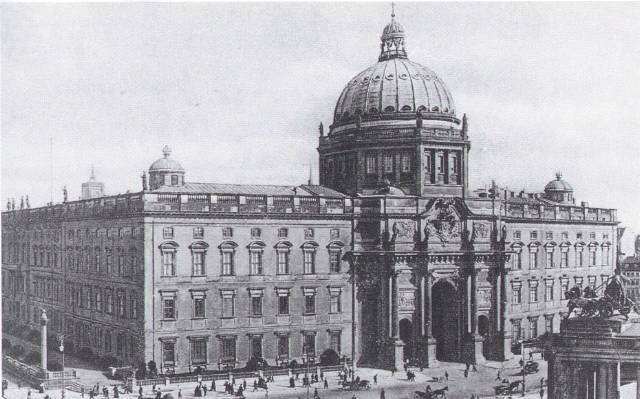 |
| Berliner Schloss http://www.robothek.de/Schloss/Original.JPG |
The SED then built a cultural center for East Berlin where the
castle once stood. That building was later demolished after the reunification
of Germany and the castle is now being rebuilt.
 |
| The Palace of the Republic http://graphics8.nytimes.com/images/2006/01/09/arts/Ouro3650.jpg |
Thinking
of Berlin as a mecca for freedom is not something the general public typically
thinks about. But, it was just that in the 1600’s. In order for Berlin to gain
a population, the ruler offered freedom to those prosecuted for religious
reasons among others. This led to a large Jewish community in Berlin. The
liberal ideals of Berlin were continued by Frederick the Great. But, he also
brought militarized ideals as well. These two conflicting ideals get to the
heart of Berlin throughout its history. One side of Berlin is wildly liberal;
focused on freedoms of choice, sexuality, thought, and life. The other side of
Berlin is covered in anger and bloodshed that stem from the militarized ideals.
How can one city have two completely separate tracks that never intersect in a positive
way? We can examine Berlin in the 1920’s, which was a sexual revolution in the
world. But, once the Nazi party came into Berlin to fight against this
liberalism, the face of Berlin changed dramatically. The ideals of Berlin seem
to flip flop from one extreme to another. To this day Berlin deals with clashes
in the streets, while still being a mecca for liberal freedoms. I think it is
important to understand both ideals that Berlin has had woven into its history
because it can help us understand the history of Berlin and what it means to be
a Berliner.

No comments:
Post a Comment